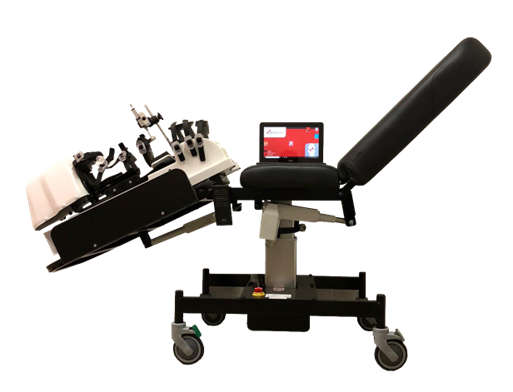

Genourob Dyneelax®
Automated Knee Laxity.
The Dyneelax system represents the clinical gold standard in motorized knee joint laxity and stiffness assessment, allowing for a force trace of the knee ligament structures. By applying computer-controlled translation forces, it records precise tibial displacement curves to accurately identify ACL damage, graft compliance, and post-surgical stiffness.
Healthcare Interoperability Native
Dyneelax integrates actively with the Just Kinetics Nexus clinical registry. Tibial translation measurements, dynamic curves, and limb symmetry calculations are instantly exported as FHIR-compliant MSK Observations to your local EHR or insurer platforms.
Pilot Site Installation & Calibration Logs
The master calibration registry confirms that Dyneelax Serial Number '[ANONYMISED]' is active, calibrated, and deployed at our Pilot Center Alpha (UK).
| Calibration Check Parameter | Tolerance Limit | Measured Deviation | Status |
|---|---|---|---|
| Anterior Drawer Force (134 N) | 134.0 N ± 2.0 N | 134.1 N | Pass |
| Anterior Drawer Force (250 N) | 250.0 N ± 3.0 N | 249.8 N | Pass |
| Displacement Calibration | 0.0 mm to 15.0 mm ± 0.1 mm | Within 0.03 mm | Pass |
| Hamstring EMG Control | Threshold trigger < 15μV | 10μV (Active detection) | Pass |
| Electronic Output Stability | Noise floor < 0.5mV | 0.3mV | Pass |
| Tibia Dynamic Loading Alignment | 90° vertical force vector ± 1° | 90.2° | Pass |
Clinical Pilot Center Alpha (Managed Service Deployed)
Certified by: Decayed Factory Engineer. Clinical Practitioner Training: Complete.
Clinical Capabilities
Dyneelax automates dynamic laximetry to extract parameters that standard manual assessments cannot measure.
Differential Displacement Curves
Measures precise anterior tibial translation at multiple force points (134N, 200N, 250N) to identify ligament compliance slopes and differentiate between partial and complete tears.
Biofeedback EMG Monitoring
Integrated surface electromyography (sEMG) monitors patient hamstring activation to detect muscle guarding or co-contraction, guaranteeing that test curves capture purely passive translation.
Longitudinal Graft Assessment
Tracks joint stability parameters throughout the rehab process (6, 9, and 12 months post-op) to evaluate early solicitations and optimize graft stiffness trends before sports return.